Does SumUp Register meet the Norwegian Cash Register Act? Requirements and checklist
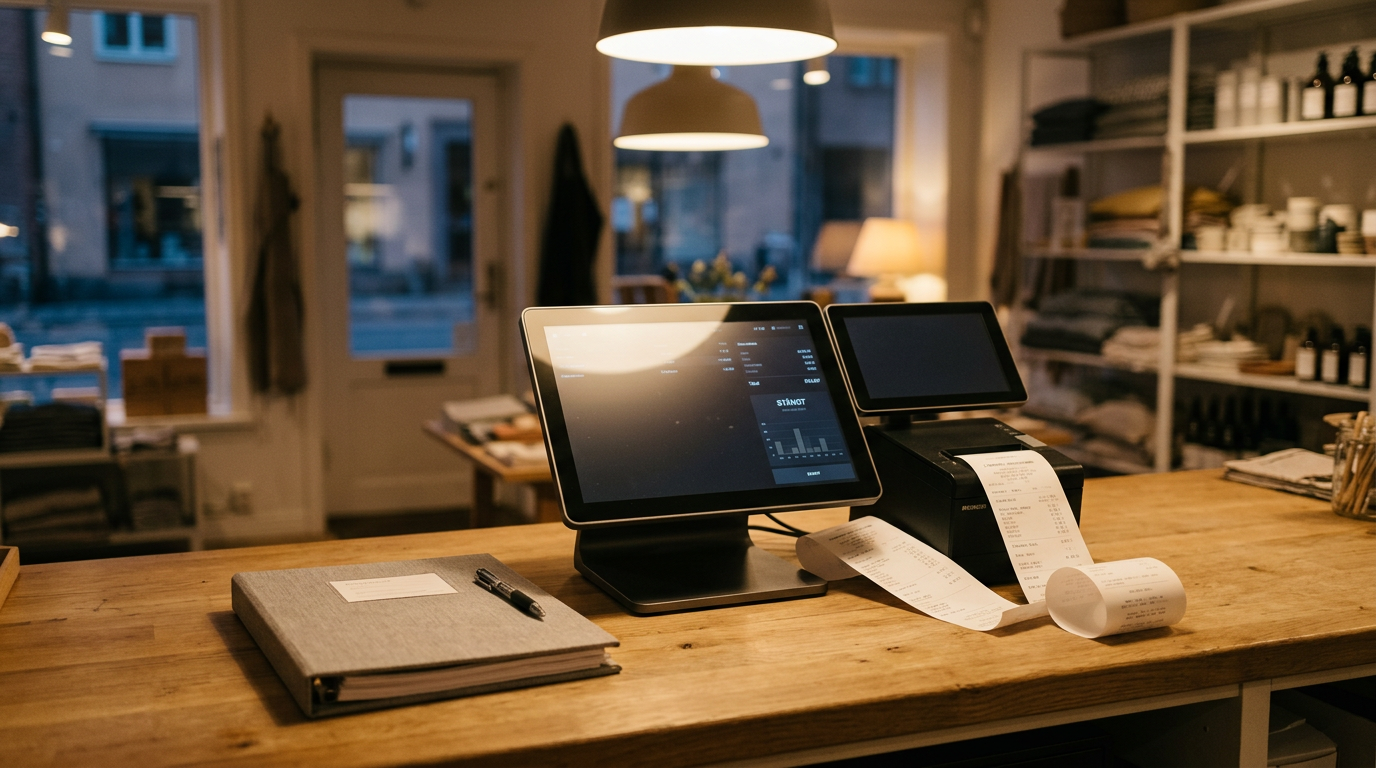
Short answer: SumUp Register is built to meet the requirements of Norway’s Cash Register Act, and according to SumUp, fiscal compliance is built in at no extra cost. The electronic journal, receipts, end-of-day reports and data export are part of the POS software, not an add-on module. But a POS system is not compliant on paper alone: the specific configuration sold in Norway must have a product declaration registered with Skatteetaten — and responsibility sits with you as the business owner.
What does the Cash Register Act require?
The rules are set out in the Cash Register Act and Regulations from 2015. Since 1 January 2019, Norwegian businesses that must keep accounts and have cash sales have been required to use a POS system with a product declaration. “Cash sales” here means sales where the customer pays on the spot — including by card — so the requirement covers most businesses selling over the counter.
The law splits responsibility between two parties. The supplier must submit a product declaration to Skatteetaten confirming the system meets the requirements. You must use a system with such a declaration and keep the sales data. A compliant POS system must, among other things, be able to:
- issue a sales receipt for every sale
- keep an electronic journal that records every entry as it happens
- prevent completed sales from being deleted or changed without a trace
- produce an X report (status during the day) and a Z report (end-of-day)
- export the journal in SAF-T Cash Register format when Skatteetaten asks for it
How SumUp Register covers the requirements
The functions the law requires come with the POS software, with no separate licence. The table shows how the requirements map to what Register does in practice.
| Requirement | What it means | SumUp Register |
|---|---|---|
| Electronic journal | Every sale is stored as it happens and cannot be altered unseen | Each sale is recorded in the POS software with a full trail |
| Receipt | The customer must be able to get a receipt | Printed via an external printer or sent digitally |
| X and Z reports | Documenting the day’s takings | Real-time and end-of-day sales reports |
| SAF-T Cash Register | Data must be deliverable on inspection | Export in the standard format — confirm for the Norwegian version |
| Product declaration | The supplier confirms the system complies | Ask SumUp to confirm the Norwegian declaration |
The point is that compliance is not something you have to build yourself. That makes Register a safe choice for a business replacing an old cash register without studying every clause. For the screens, price and setup, see our separate guide to what SumUp Register is.
Checklist before you switch POS system
No supplier can promise your exact setup is compliant unless the configuration has a product declaration. Run these checks before moving your whole till over:
- Ask for the product declaration. Get written confirmation that the Norwegian Register configuration is registered with Skatteetaten.
- Test the SAF-T export. Check that you can actually pull the journal out in SAF-T Cash Register format.
- Settle cash handling. If you take cash, the till must record both card and cash — Register does both, but a cash drawer is sold separately.
- Talk to your accountant. Confirm what applies to your industry, and whether you qualify for an exemption for limited cash sales.
- Keep the records. Store receipts, reports and journal data for as long as the bookkeeping rules require.
Worth knowing: SumUp processes Norwegian debit cards as Visa or Mastercard, not over BankAxept. It does not affect compliance, but if your card volume is very high, compare the total cost with a bank terminal that supports BankAxept.
What does compliance cost?
With Register you pay nothing extra for compliance. You pay a one-off hardware price (NOK 4,399 at Elkjøp, ordered online) and 1.49% per card payment, with no monthly fee or contract. Accessories such as a receipt printer and cash drawer are extra. With Payments Plus (NOK 349/month) the rate drops to 0.79%, which pays off from around NOK 50,000 in monthly card turnover.
If you only take cards and have little or no counter sales, a simpler card reader may be enough. See our comparison of Solo Lite, Terminal and Register to find the right level.
Read our full SumUp review — fees, setup and how it compares with the competition.
Visit providerFrequently asked questions
Does SumUp Register meet the Cash Register Act requirements?
Register is built for the requirements, with an electronic journal, receipts, X and Z reports and data export included at no extra cost. What matters is that the Norwegian configuration has a registered product declaration with Skatteetaten, so ask SumUp to confirm this before switching.
What is SAF-T Cash Register?
SAF-T Cash Register is the standard format Skatteetaten uses to extract sales data from a POS system during an inspection. Every system covered by the Cash Register Act must be able to export its journal in this format.
Who must use a POS system with a product declaration?
The main rule covers businesses that must keep accounts and have cash sales — typically cafés, restaurants, shops, hairdressers and salons with a fixed counter. Businesses with limited cash sales may be exempt. Check with your accountant what applies to you.
Does it cost extra to make Register compliant?
No. According to SumUp, fiscal compliance is included in the POS software with no licence or monthly fee. You pay for the hardware, any accessories and 1.49% per card payment.
Advertiser disclosure: We may earn a commission when you click links to providers. This never affects our ratings.
SumUp Solo
Read review